İçindekiler (3)
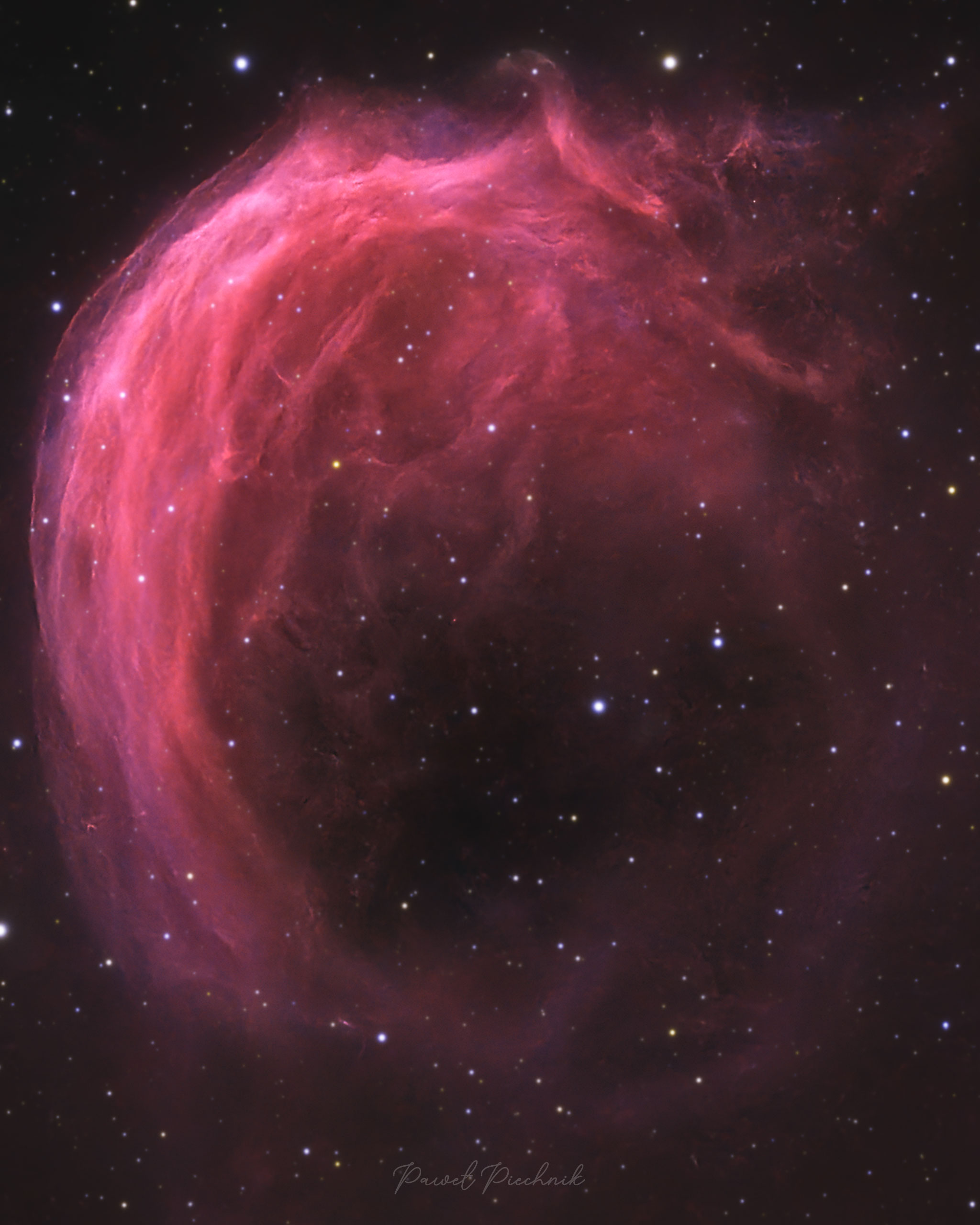
Executive Summary: Sh2-188 (Sharpless 2-188), popularmente known as the "Shrimp Nebula," provides an extraordinary observational laboratory for studying the late-stage evolutionary dynamics of intermediate-mass stars interacting with the ambient interstellar medium (ISM). Unlike canonical planetary nebulas that display spherically or axisymmetrically distributed expanding shells, Sh2-188 exhibits an extreme structural asymmetry defined by a striking, brightened swirl and a pronounced bow shock on its leading edge. Captured through precision narrowband filtering in the light of hydrogen, sulfur, and oxygen, this deep optical record reveals how the high-velocity transit of an evolved white-dwarf core—the stellar relic remaining after the progenitor star sheds its outer atmosphere—plows through ambient galactic material, actively compressing, heating, and brightening the local gas along its kinematic trajectory.
1. Astrophysical Classification and Morphological Peculiarities of Sh2-188
Cataloged primarily within the Sharpless Catalog of H II regions as Sh2-188, this complex celestial structure was historically misclassified due to its filamentary, arc-like optical morphology, which mimics the appearance of a supernova remnant. Rigorous spectroscopic inspections, however, have definitively reclassified Sh2-188 as an evolved planetary nebula. A planetary nebula marks the terminal evolutionary phase of low- to intermediate-mass stars (comparable to our Sun), occurring when the star exhausts its nuclear core fuel, ascends the asymptotic giant branch (AGB), and ejects its outer gaseous envelope via powerful stellar winds.
In standard textbook models, the thermal expansion of an ejected circumstellar envelope into a static or low-density ambient environment produces symmetrical ring-like, bipolar, or elliptical geometries. Sh2-188 departs radically from this canonical morphology. The nebula exhibits an intensely asymmetric filamentary crescent that abruptly fades into a diffuse, tenuous, and disjointed counter-structure, giving rise to its colloquial designation as the Shrimp Nebula. The most prominent optical feature is the intensely luminous, curved bow structure concentrated on the upper-left boundary of the system, accompanied by intricate, curling gas filaments extending into the wake.
2. The High-Velocity Bow Shock: Hydrodynamics in the Interstellar Medium
The decisive physical mechanism governing the visual presentation of Sh2-188 is the unusually high spatial velocity of its central stellar remnant relative to the surrounding interstellar medium. The white-dwarf core left behind by the progenitor star is not stationary relative to the ambient galactic gas; instead, it is undergoing rapid kinematic transit through interstellar space.
This dynamic interaction directly replicates the hydrodynamics of a marine vessel plowing through water. As the high-velocity white dwarf and its remnant expanding wind plow through the local ISM, a classical bow shock is generated on the leading edge of motion:
- Gas Compression and Kinetic Heating: The ambient interstellar gas cannot disperse instantaneously as the stellar ejecta pushes forward. Consequently, material along the leading edge undergoes severe aerodynamic compression. This mechanical compression converts a fraction of the core's bulk kinetic energy into thermal energy, significantly elevating the localized density and temperature of the gas.
- Shock-Induced Brightening: Because optical radiative recombination and collisional excitation rates scale strongly with local gas density, the compressed leading edge emits far more intensely than the unperturbed trailing sections. This explains why the upper-left perimeter shines with exceptional brilliance while the opposite side appears drastically faded or depleted.
- Wake Turbulence and Swirling Filaments: As the dense forward shock sweeps past ambient inhomogeneities, fluid instabilities—such as Kelvin-Helmholtz and Rayleigh-Taylor shear instabilities—develop along the shock boundary. These hydrodynamic shears twist the expelled stellar material into the delicate, multi-tiered gaseous swirls recorded in high-resolution optical exposures.
3. Angular Dimensions, Scale, and Observational Constraints
Despite its exceptionally faint surface brightness, Sh2-188 ranks among the largest planetary nebulas visible in the nocturnal celestial sphere when evaluated by angular size. The entire gaseous structure subtends an angular diameter equivalent to approximately half the diameter of the Moon (approximately 15 arcminutes across).
Translating an angular diameter of half a degree into physical dimensions highlights the ancient, expanded nature of the nebula. When planetary nebulas first form, they occupy compact spatial volumes spanning fractions of a light-year across. As the gas shell expands over dozens of millennia, its surface brightness drops precipitously as the material disperses into interstellar space. For Sh2-188, reaching an angular footprint this vast indicates an advanced evolutionary age, wherein the outer shell has expanded extensively, allowing the surrounding ISM interaction to completely dominate the macroscopic morphology over intrinsic stellar wind pressure.
4. Multi-Wavelength Optical Synthesis: Hydrogen, Sulfur, and Oxygen
The featured observation, acquired utilizing a precision backyard optical telescope in Krakow, Poland, leverages specialized narrowband astrophotographic techniques to decouple distinct ionic emission signatures from broadband atmospheric light pollution. The composite image maps critical atomic transitions within the ionized plasma:
Hydrogen-Alpha ($H\alpha$) Transitions
Hydrogen constitutes the vast majority of the baryonic mass ejected by the red giant progenitor. Recombination emissions occurring as free electrons cascade into lower energy states—specifically the Balmer-alpha line at 656.3 nm—delineate the bulk distribution of the nebula's outer envelope and highlight the structural boundary of the primary shock wave.
Singly Ionized Sulfur ([S II]) Shock Tracers
The forbidden optical emission doublet of singly ionized sulfur ([S II] at 671.6 nm and 673.1 nm) is an exquisite diagnostic tool for identifying shock-excited interstellar gas. While photoionization from the hot central white dwarf excites gas throughout the nebula, strong [S II] emission relative to $H\alpha$ serves as an unambiguous signature of shock compression and collisionally heated gas along the leading bow boundary.
Doubly Ionized Oxygen ([O III]) Core Radiation
The forbidden line of doubly ionized oxygen ([O III] at 500.7 nm) requires hard ultraviolet (UV) photons with energies exceeding 35.1 eV to ionize $O^+$ into $O^{++}$. This optical channel directly traces high-energy radiation emanating from the surface of the blistering, compact white-dwarf core, mapping regions of peak photoionization and high-temperature plasma pockets.
Following high-precision CCD integration through these narrowband filters, the individual spectral bands were digitally registered, balanced, and calibrated to synthesize a visual representation that closely approximates the nebula's true-color physical characteristics while maximizing structural contrast across faint filamentary boundaries.
5. Scientific Significance in Stellar Lifecycles and Galactic Chemical Enrichment
High-velocity planetary nebulas such as Sh2-188 provide essential empirical benchmarks for contemporary stellar evolution and galactic dynamics models:
- Chemical Enrichment Feedback: Planetary nebulas act as fundamental mechanisms for recycling nucleosynthetic products—including intermediate elements such as carbon, nitrogen, and oxygen synthesized during asymptotic giant branch phases—back into the interstellar medium to enrich subsequent generations of star and planet formation.
- Quantifying ISM Microstructures: By measuring the curvature, compression factor, and radiative cooling rates of the bow shock, astrophysicists can indirectly calculate the ambient density, magnetic field orientation, and temperature of the unperturbed local interstellar medium surrounding the solar neighborhood.
- Stellar Kinematics: Resolving the proper motion and radial velocity of the central white dwarf helps establish the kinematic history of the progenitor star, identifying whether it was gravitationally perturbed, underwent a binary ejection mechanism, or acquired runaway stellar velocities across its galactic orbital plane.
6. Primary Archival Documentation and Formal Reference
Primary Archival Abstract & Summary:
What causes the swirl in the Shrimp Nebula? Its high speed is likely. What is sure is that Sh2-188 is one of the larger planetary nebulas on the night sky, by angular size, spanning about half the diameter of the Moon. Moreover, the white-dwarf core -- leftover from the Sun-like star that shed its outer atmosphere -- is moving unusually fast through interstellar space, creating a bow shock most visible on the upper left that is similar to a boat plowing through water. Although faint, the Shrimp Nebula glows also by compressing and brightening gas on its leading edge. The featured image was taken in the light of hydrogen, sulfur, and oxygen by a backyard telescope in Krakow, Poland and then digitally adjusted to approximate the nebula's true colors. APOD's email for image submissions has changed. Please see: APOD Submissions APOD's main NASA site has moved: From apod.nasa.gov to science.nasa.gov/apod
- Contributing Researcher / Astrophotographer: Pawel Piechnik
- Document Catalog Identifier: NASA-APOD:2026-09-29
- Archival Registry Date: September 29, 2026
- Permanent Primary Portal: NASA Astronomy Picture of the Day (APOD Archive)
- Source Agency Portal: National Aeronautics and Space Administration (NASA)
Standard Archival Reference:
Pawel Piechnik (2026). Sh2-188: The Shrimp Nebula. NASA-APOD:2026-09-29. https://apod.nasa.gov/apod/ap260929.html
BibTeX Entry:
@misc{nasa_apod_20260929,
  author       = {Pawel Piechnik},
  title        = {{Sh2-188: The Shrimp Nebula}},
  howpublished = {NASA Astronomy Picture of the Day},
  year         = {2026},
  url          = {https://apod.nasa.gov/apod/}
}
Henüz yorum yapılmamış. İlk yorumu siz yapın!